
Professional Certification of Road Safety Auditors
Becoming a Certified Road Safety Auditor
Road Safety Auditors lead Audits and targeted Inspections, and must have certificates of competence and experience in road design, RS engineering, accident analysis.
To become a certified auditor, training should be done initially and then periodically to maintain accreditation as and advance in level from Observer, to Team Member and eventually to Team Leader.
Start your path to become a Certified Road Safety Auditor
This path is more suitable to people that have an undergraduate degree in civil engineering or related areas, as a basis to build knowledge upon, and some experience in road engineering. Academic and practical knowledge of traffic regulations and the Safe System would be a big plus for anyone considering following this path.
The development of expertise in road safety is usual for transit, engineering and infrastructure authorities, engineering boards, private consultants (engineering design and audit) and in terms of expertise, this area of knowledge is very valuable for road concessionaires or PPP operators, private engineering and for construction companies.

Interested individuals in pursing the certification for Road Safety Auditor must have:
- Acquired a good understanding of the science of road traffic Casualty Reduction or Collision Investigation.
- Know how to take steps to implement measures which are designed to reduce the risk of recurrence of future similar crashes.
- Aim to reduce road traffic casualties and to improve road safety through engineering and best practices.
- Aim to provide completely unbiased and independent technical expertise and reports.
To achieve this first level, of Road Safety Audit Team Observer, applicants must have:
- Minimum of one year of experience in Collision Investigation (CI) and/or Road Safety Engineering (RSE). This is a background to be able to audit roads and highways.
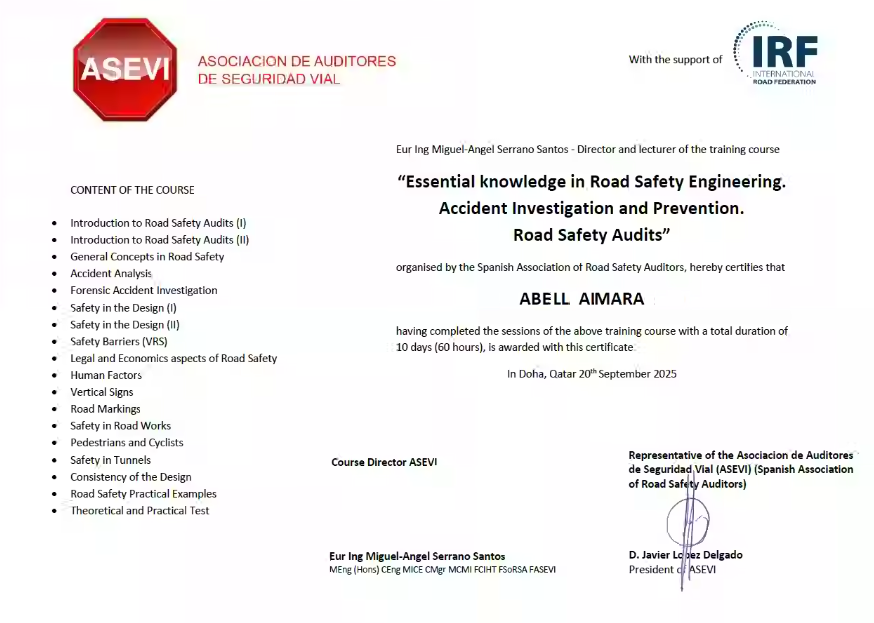
- Complete the 10-day/60 hour initial course for RS Auditors “Essential Knowledge in Road Safety Engineering, Accident Investigation and Prevention Road Safety Audits”, this is a course that requires approving the final examination.
ASEVIs certification as Observer will be granted to those students that approve the ending exam of the initial course.
To achieve this second level, of Road Safety Audit Team Member, applicants must be able to demonstrate more knowledge acquired through experience and related training, this includes:
- Having qualified as Observer, after attending and approving the initial training.
- At least two years’ experience in Collision Investigation and/or RSE;
- Completed at least five Road Safety Audits (RSAs) as Member or Observer in the past 24 months;
- Completed a minimum of two days CPD in the field of Road Safety Audit, CI and/or RSE in the past 12 months.
This is the highest professional certification level, of Road Safety Audit Team Leader, based on experience being an Audit Team Member in several audits and demonstrating significant expertise in the area, to achieve this level:
- Already achieved the necessary training to become an Audit Team Member;
- At least four years’ experience CI and/or RSE experience;
- Completed at least five RSAs in the past 12 months as a RSA Team Leader or Member;
- Completed a minimum of two days CPD in the fields of RSA, CI and/or RSE in the past 12 months.
In addition to the above, local authorities may require completion of specific training requirements, such as in some countries is the case for high-speed traffic in highways.
The candidate must submit the information to ASEVI, which will review it and issue a recommendation and a certification.
Please check our review and certification services and corresponding fees.
Road Safety Auditor
Professional Certification
The Professional Certification as Road Safety Auditor issued by ASEVI is verifies the competence to implement best practices and standards in Road Safety Audits using the Safe System and as per EU and UK regulations. This enables RS Auditors to perform activities such as the EU´s Road Infrastructure Safety Management (RSIM). ASEVI´s certification follows the agreed standard educational requirements and progress levels agreed by ASEVI with SoRSA (UK), FASR (Portugal) and IRF Official (Switzerland) as the most relevant standard in RS Auditors certification.
The professional certification follows a set course of training hours and practical experience starting from Observer level, then to Team Member and leading towards the Team Leader Certification. As part of a rigorous academic formation, the courses are followed by examination previous to accreditation.
Advancement to the next level in the path to Team Leader requires demonstration of the candidate work in road safety audits.
EU Requirements for Road Safety Auditor Certification

ASEVI aims to help new countries incorporate best practices to save lives in Road Safety, bringing knowledge and implementing the Safe System approach wherever possible.
The European Union requirements for RSAs are defined under Directive 2008/96/EC and updated by EU Regulation 2019/1936, on Road Infrastructure Safety Management, which applies to all EU member states. Key points are:
- Mandatory Certification: Road Safety Auditors working on the Trans-European Road Network (TERN) must hold a Certificate of Competence.
- Training & Qualifications: Auditors must complete specialized training in road safety engineering and auditing. This typically includes:
- Technical education in civil engineering or a related field
- Professional experience in road safety planning and accident analysis.
- Completion of an approved RSA/RSI seminar and passing an exam.
- Continuous Professional Development (CPD): Certified auditors must maintain competence through ongoing training and CPD activities. Auditors must be independent of the design team to ensure unbiased safety assessments.
Road Infrastructure Safety Management, RSIM, application guidelines
The Road Infrastructure Safety Management (RSIM) is the system established by the European Union to guarantee road safety at all stages of the infrastructure lifecycle. Based on Directive 2008/96/EC, RSIM defines mandatory procedures for evaluating, auditing, and maintaining road safety, from initial planning to ongoing operation. Its main objective is to reduce accidents through a preventive and corrective approach, ensuring that roads meet high safety standards.
EU Member States, as per the European Commission must implement the Road Infrastructure Guidelines following structured processes for roads under the directive’s scope (TEN-T, motorways, primary roads, and EU-funded interurban roads).
Global best practices in action:
Areas of action for Certified Road Safety Auditors
Road Safety Impact Assessments (RSIA)
RSIA are strategic-level assessment carried out at the planning stage of a new road project or a major modification. With the purpose of evaluating the impact on road safety before construction begins, considering alternative design options. Its focus is on predictive analysis of how the project will affect accident risk and safety performance.
Legal Basis: Required under Directive 2008/96/EC, Article 3.
- Conducted during the planning phase of infrastructure projects.
- Evaluates how proposed changes affect safety and identifies risks early.
Road Safety Audits (RSA)
Independent, detailed, systematic and technical safety check of the design characteristics of project. Apply to all stages: Draft design, detailed design, pre-opening, early operation. Its purpose is to identify potential safety issues during design, construction, and early operation phases.
RSAs are conducted at different phases (feasibility, preliminary design, detailed design, pre-opening), with the goal to ensure that safety considerations are integrated into the project lifecycle.
- Independent audits at four stages: draft design, detailed design, pre-opening, and early operation.
- Ensures safety is integrated throughout design and construction.
Network-Wide Road Safety Assessments (NWRSA)
NWRSAs evaluate accident and impact severity risk, based on a visual examination of road, characteristics (in-built safety), serious accidents statistics over 3 years.
Results in a minimum of 3 categories, recommended in 5: High risk, medium-high, medium, low-medium, low.
Worst sections are to be followed by targeted inspections and remediation, done every 5 years.
- Mandatory, repeated every 5 years.
- Classifies road sections by risk using both reactive (crash data) and proactive (design features) approaches.
Results must be published and followed by targeted inspections or remedial actions.
The methodology combines:
- Proactive approach: Based on design and operational features (lane width, curvature, junction design, roadside layout).
- Reactive approach: Based on historical crash data.
The outcome of the NWRSA assigns a safety rating (5-level scale) to each road section to prioritize interventions.
In the EU the first assessment of motorways and primary roads was required from 2024, then periodically.
Periodic Road Safety Inspections (PRSI)
PRSI are regular inspections of roads in operation to detect defects and hazards, and aimed to maintain safety standards and prevent deterioration that could lead to accidents. Its scope includes checking signage, road markings, barriers, lighting, and roadside conditions; and its frequency should be defined by national guidelines but aligned with EU recommendations.
PSIs tend to be correlated with maintenance (to re-establish safety features). Sufficiently frequent.
The EU Guideline indicates application based on national guidelines for road works, and implement joint teams to inspect tunnels, at maximum 6 years.
Targeted RS Inspections on blackspots, sections with serious accidents, as part of network wide RS Assessments. Can evaluate the design principles and can trigger actions to remediate.
- Regular inspections of roads in operation to maintain safety standards. Typically every 5 years. This can be internally done by the concessionaire.
Note that PSI is the mandated EU regulated inspections applying standard RSI (Road Safety Inspections) that can be done on demand.
Focused Road Safety Inspections (FRSI)
Targeted road safety inspections are focalized reviews on blackspots or sections with serious accidents. This can be part of network wide RS Assessments. FRSI can evaluate the design principles and can trigger actions to remediate.
Note that PRSI are the mandated EU regulated inspections applying standard RSI (Road Safety Inspections). PRSI and FRSI can be done on demand.