Training & Education
Advancing Expertise in Road Safety
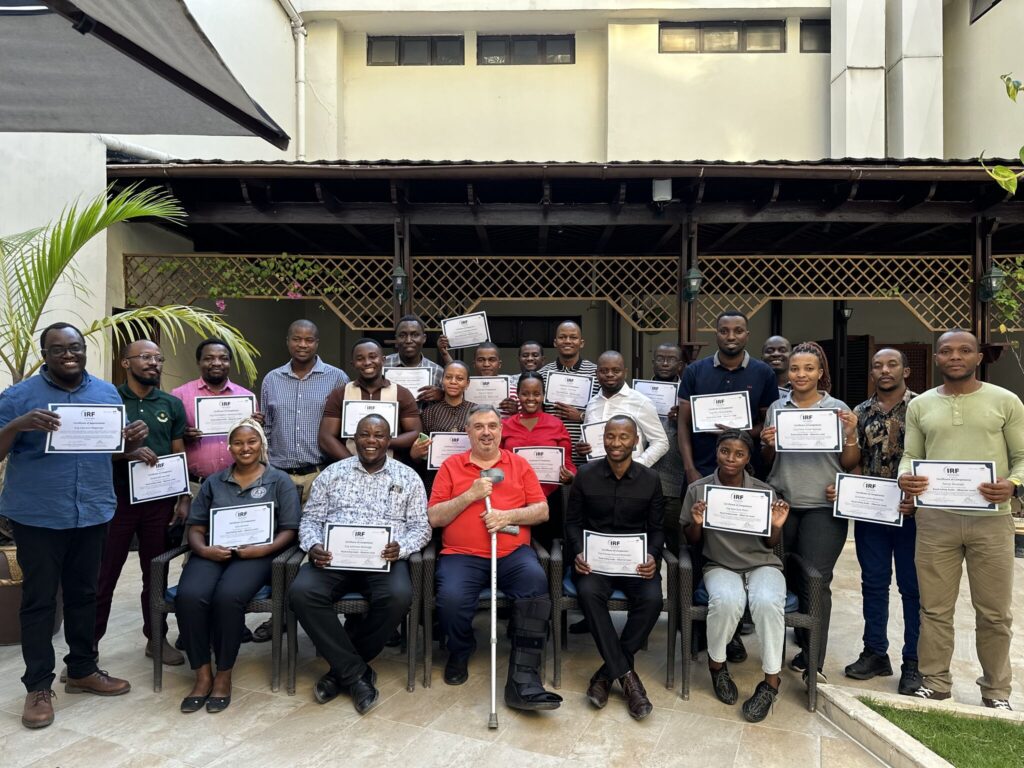
ASEVI provides extensive training in Road Safety related areas, including the master course for Road Safety Auditors leading to global professional certification, and other non-certification related courses.
Our core 10-day course for Road Safety Auditor is the only tested EU, UK compliant training that fully incorporates the Safe System in every step.
ASEVI´s professional certification is accepted at SoRSA, FASR and IRF Official.
Road Safety Auditors Certification path
EU and UK compliant training towards RSA Certification accepted by the IRF, SoRSA and FASR.
CPD Training
Standard Courses
Customized local training
“Knowledge that Saves Lives: Certifying road safety auditors to the deliver the Safe System approach principles worldwide.”
Asevi’s training and certification programs are designed to advance Road Safety expertise and the Certification of Road Safety Auditors. Our training is aligned with the Safe System Approach and support the global vision of Vision Zero, eliminating road fatalities and serious injuries. As a non-profit operation, we aim to maximize accessibility, our programs empower individuals and institutions worldwide with the knowledge and skills needed to implement sustainable road safety solutions. By building capacity through education, we enable individuals, governments, concessionaires, and practitioners to conduct effective road safety audits and embed safety principles across the entire infrastructure lifecycle. This approach ensures tangible, measurable impact—reducing crashes, saving lives, and strengthening communities. Our commitment to knowledge transfer and practical delivery makes training not just an educational service, but a cornerstone of sustainable development and public benefit.
Why ASEVI
Global leader in RS Auditors Certification standards as agreed with SoRSA, FASR and the IRF. ASEVI´s training leads to recognized certification accepted internationally.
- Global recognition: ASEVI´s certification is accepted internationally
- Hands on: In person delivery for better transfer of knowledge.
- Reputation: Outstanding feedback from course participants.
- Experience: trained in almost every continent since 2009.
- Auditor´s path: Only EU, UK approved training incorporating the Safe System approach.
What You Get
Global standards and best practices aligned with EU and UK regulations and with the Safe System.
- RS Auditors: Path to formal internationally recognized certification.
- Opportunity to be in the global registry and of membership.
- RS professionals: Global best practices.
- Transportation entities: Knowledge adjusted to local needs.
- Donors: Better delivery and use of your contributions for local capacity building, complemented with technical assistance to ensure systemic integration and sustainability.
Road Safety Training Courses
Training and Professional Certification in Road Safety, delivering qualifications, expertise and skills required by authorities, regulators, investors and financiers.
Road Safety Auditor - Professional Certification

This is the main Road Safety Auditors Certification Course
Objective: This course provides essential training for professionals beginning their journey toward Road Safety Auditor Professional Certification. It equips participants with the knowledge and skills to identify and mitigate road safety risks, conduct effective audits and inspections, and apply international best practices to prevent traffic accidents and fatalities. The curriculum covers technical, legal, and practical aspects of road safety, including accident investigation, safe infrastructure design, human factors, and work zone management. Successful completion prepares candidates for international professional accreditation and progression within the Road Safety Auditor career path.
ASEVI´s certification is accepted by SoRSA, FASR, and IRF Official.
Target Audience: Professionals with a university degree, preferably in engineering, and at least two years of relevant experience in road design, maintenance, or construction. The course is designed for those seeking foundational knowledge and international certification as Road Safety Auditors.
Duration: 10 days / 60 Hours. It is a comprehensive program with practical and theoretical modules.
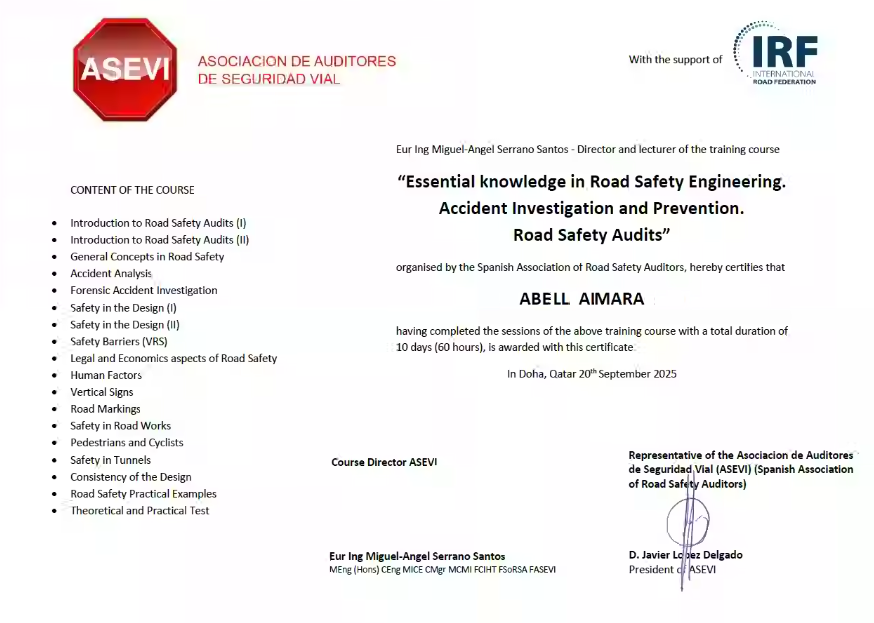
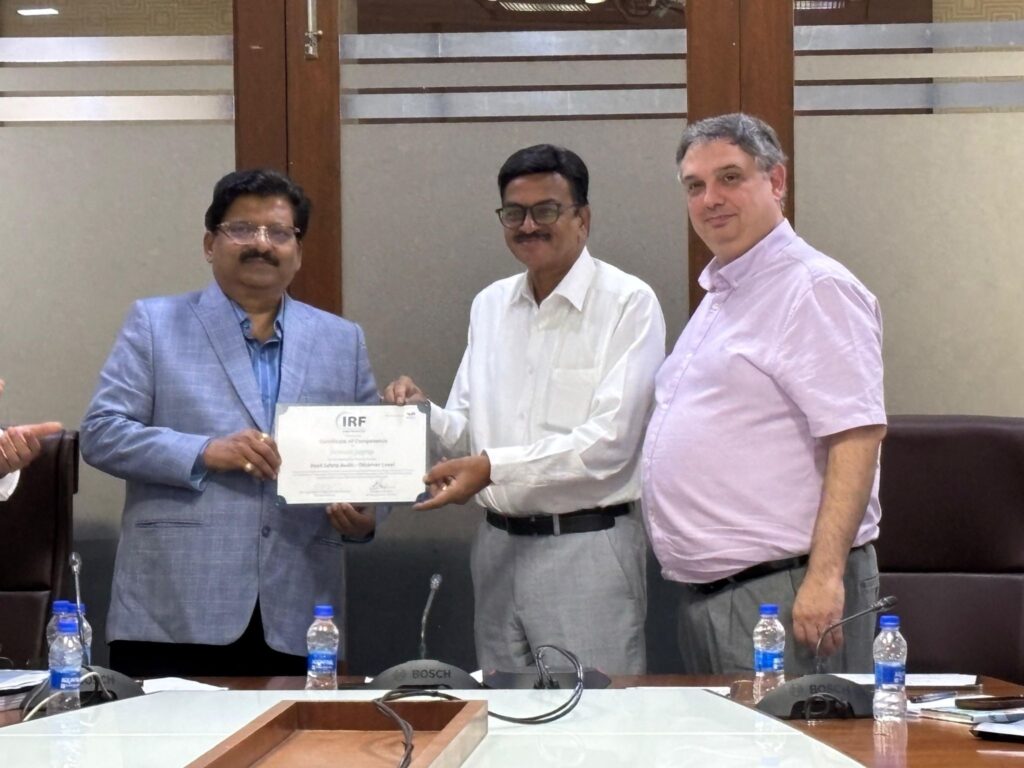
Exam and Certification: The students that approve the exam attain the “Observer” level of RS Auditor Certification, and qualify to be included in the Road Safety Registry.
Modality: in person, with full dedication during the full duration of the course.
Number of participants: 15-20 (max per course).
Introduction to Road Safety Audits - RSA
Objective:
Introduce participants to preventive risk assessment tools such as road safety audits and inspections, focusing on identifying and mitigating risks in road design and traffic control to reduce crashes and casualties.
Target Audience:
Road authorities, engineers, traffic safety professionals, and anyone involved in road safety planning and operations.
Duration:
3 days.
Modality: In person.
Road Safety for Managers - Stragic Leadership in Road Safety
Objective:
Empower managers with strategic understanding and leadership tools to champion road safety initiatives, support auditors, and align infrastructure decisions with safety outcomes. The course emphasizes oversight, governance, and a legacy of saving lives.
Target Audience:
Managers and leaders in road safety, infrastructure, and public works seeking to enhance their strategic and operational impact.
Duration:
2 days (or 3 half-days).
Modality: On line.
Site Traffic Management Supervisor - STMS
Objective:
Certify experienced traffic controllers as supervisors, equipping them with advanced skills in legal compliance, risk management, team leadership, and stakeholder communication for complex or high-impact worksites.
Target Audience:
Experienced traffic controllers seeking supervisory certification and leadership roles in traffic management.
Duration: 2 days.
Modality: In person, however this course can be taken remotely/virtual.
Site Traffic Management Personnel - STMP
Objective:
Certify experienced traffic controllers as supervisors, equipping them with advanced skills in legal compliance, risk management, team leadership, and stakeholder communication for complex or high-impact worksites.
Target Audience:
Experienced traffic controllers seeking supervisory certification and leadership roles in traffic management.
Duration: 1 day.
Modality: On line.
Work Zones Management
Objective:
Train participants to design and manage safe work zones, applying the Work Zone Traffic Management Guide, and utilizing the latest technologies and best practices for the safety of motorists and workers.
Target Audience:
Road agency executives, engineers, traffic safety professionals, planners, consultants, law enforcement, contractors, and road product suppliers.
Duration:
3 days.
Modality: In person.
Truck Mounted Attenuator - TMA
Objective:
Equip participants with the knowledge and skills to safely operate, position, and integrate Truck Mounted Attenuators (TMAs) in work zones, ensuring optimal protection for workers and road users. The course covers operational mastery, compliance, incident response, and integration with broader traffic management plans.
Target Audience:
Personnel responsible for deploying and operating TMAs, including traffic management staff, site supervisors, and contractors working in high-risk road environments.
Duration: 1 day.
Modality: On line.
Custom-Made Courses
Objective:
ASEVI can adapt and create custom-designed courses to attend specific requirements, usually to adapt to local regulations, languages, specific conditions of the target road network, or specific profile of the institution that requires the training.
We have delivered many custom-made training courses both on site and arranged visits by foreign students to important institutions in Spain. We have also collaborated with Universities in the delivery of specific content, in person and virtually.
The Target Audience and Duration can be adapted.
Testimonials
Road Safety Auditor´s Professional Certification
This course leads to achieving the Professional Certification as Road Safety Audit Observer level.
The course is intended for people that work or aim to work in Road Safety Audits or on Inspections as a career path. It leads to professional certification and opens the possibility to, with experience, achieve higher levels such as Road Safety Audit Team Member and eventually Road Safety Audit Team Leader.
- Type: In Person.
- Languages available: English, Spanish.
- Qualifies for RS Auditor Certification: Yes.
- Test Required: Yes.
- Duration: 10 days, 60 hours.
- Max. No. of students per course: 20.
Certifying road safety auditors to the deliver the Safe System approach principles worldwide
The certification after approving the exam at the end of this course is valid at SoRSA, FASR and IRF Official.
1. Course Description
Preventive risk assessment tools, such as road safety audits and inspections, are an effective and essential instrument to help road authorities reduce the number of accidents and casualties, since design standards alone cannot guarantee road safety under all conditions.
Risk assessment procedures can generally be applied at successive stages of road planning, design, opening, and operation. They all share the common purpose of identifying risk factors related to road design or traffic control that can cause accidents or exacerbate existing ones. In many cases, they help network road operators and city traffic departments identify engineering weaknesses and hazardous road sections, even in the absence of robust traffic injury data.
According to the World Health Organization’s (WHO) 2023 Global Status Report on Road Safety, more than two people die on the road every minute, or in other words, more than 3,200 people die every day in road traffic accidents somewhere in the world. There are 1.19 million road traffic fatalities each year, and more than 50 million people are left with lasting injuries. Road traffic injuries are the leading cause of death among people aged 5 to 29. These figures suggest a striking disconnect between the theoretical merits of road infrastructure safety management and the real-world outcomes experienced by countless road users every day. These statistics highlight the need for professionals to receive comprehensive training in conducting effective Road Safety Audits and to have the relevant knowledge to implement appropriate measures to prevent road deaths. As a result of this need, we offer the following Road Safety Auditor course to professionals from all over the world.
2. Modality
This course, as that leads to testing and certification, and that requires practical applications is done with a leading RS Auditor Trainer, the curse is in person.
3. Course Results / Objectives
- Learn to focus on road defects that cause serious and fatal injuries.
- Identify the risks of a road network.
- Understanding the benefits, resources, and liability issues associated with Road Safety Audits / Road Safety Inspections.
- Understand the scope of a Road Safety Audit and correctly use national and international reference manuals.
- Understanding the role and skills of each member of a road safety audit team.
- Understand what data sources are available to support corrective action recommendations.
- Understanding the general problems during the design of any project.
- Understanding the different types of collisions and how to prevent them.
- Understanding the importance of safety barriers in mitigating the consequences of accidents.
- Understanding the true monetary value we are incurring and paying due to road accidents.
- Understanding which measures can work when implemented and which ones do not.
4. Course Syllabus
| Days | Module | Topics |
|---|---|---|
| 1 | Technical and Legal Framework – Road Safety Policies |
|
| 2 | Collision Investigation – Road Safety Technology |
|
| 3 | Safe Road Infrastructure Design |
|
| 4 | Vehicle restraint systems Road Safety in Tunnels and Bridges |
|
| 5 | Factors humans |
|
| 6 | Road Safety Audit and Inspection Procedures |
|
| 7 | Road Safety in Work Zones |
|
| 8 | Practical training for rural roads and interchanges (grade-separated) |
|
| 9 | Practical training for urban roads and intersections (at grade) |
|
| 10 | Practical training for work areas |
|
5. Course Eligibility
To be eligible for the course, participants must meet the following minimum requirements:
- University degree (a degree in Civil Engineering or Mechanical Engineering is preferred. However, anyone with a university degree should be able to follow and complete this course).
- Have a minimum of two years of professional experience after obtaining the degree.
- Relevant experience through participation in road design, maintenance, improvement, and construction projects, either as a team member or as a reviewer. Participation (as a designer, contractor, or reviewer) in at least one road design or construction project.
- Basic knowledge and understanding of traffic accident analysis.
6. Course Capacity
A single course can only accept a maximum of 20 participants who meet the above entry requirements for the course. This is essential to ensure that each participant receives the highest quality instruction and learning standards. Furthermore, applicants will be enrolled in the course on a first-come, first-served basis.
If a larger number of students are interested in taking the training course, we can schedule another course to be offered to accommodate the number of participants.
7. Acreditation
Upon successful completion of the course, each participant must pass an exam before being issued an internationally recognized certificate.
This international accreditation will be provided by the ASEVI, which is acceptable to SoRSA, FASR and the International Road Federation, IRF Official. Please note that the fees for these organizations to issue (if the candidate requires) their own certificates differ.
The cost for additional certification by any of the other organizations can be clarified as soon as you decide which one you wish to use to accredit the course or whether to be included in the global registry of Road Safety Auditors. If the intention is to be included at IRF Registry, that organization may discount fees due to the agreement with ASEVI.
This ASEVI course is valid for IRF, however IRF own course accreditation fee is separate from the training course fees. Selected students will be included in the International Register of Road Safety Auditors launched October 2024 in Istanbul.
The certificate issued to candidates who successfully complete the course and pass the exams allows you to begin your career in Road Safety Auditing as an “Observer”. To progress to “Assistant Auditor” and later to “Lead Auditor/ Team Leader,” you must comply with the rules and regulations of the country you are in or of ASEVI if you want to apply to ASEVI´s Certification.
ASEVI´s standard requires that you must complete a minimum of 5 Road Safety Audits (RSAs) as an Observer, plus to 2 days of Continuing Professional Development (CPD) refresher course, and remain as an Observer for one year before progressing to Audit “Team Member”. Similar conditions apply for progressing from Team Member to “Team Leader”, which implies a minimum of two years as a Team Member, and 10 RSAs within 12 months, 2 days of CPD, and acting as Lead Auditor at briefings.
In other countries, or local context in the EU similar requirements also exist for the Lead Road Safety Auditor (Team Leader) and the Assistant Road Safety Auditor (Team Member), this also applies in the case of Saudi Arabia, Qatar, Australia, New Zealand, etc.
The training course provides the minimum knowledge an auditor should have. After that, each auditor needs to develop their skills through practice conducting audits first as an Observer Auditor, and progressing to Team Member and then to Team Leader.
8. Instructors
Eur Ing. Miguel-Ángel Serrano Santos
MEng (Hons) CEng MICE CMgr MCMI FCIHT FSoRSA FASEVI. Technical Director, ASEVI-Global Inc.
Miguel-Ángel Serrano Santos is a renowned civil engineer, a graduate of the University of Granada in Spain. He currently serves as Global Training and Certification Director for ASEVI Global Inc.
Prior to that, he worked as a Road Safety Expert for the National Road Safety Centre (NRSC) in Riyadh (Saudi Arabia), at the United Nations Office for Project Services (UNOPS) as a Senior Road Safety Specialist, and at Ashghal (Public Works Authority), where he was responsible for managing and approving all road safety audits conducted in Qatar.
He is a Chartered Member of the Spanish Association of Civil Engineers, a Board Member of the Chartered Management Institute, a Member of the Spanish Association of Traffic and Transport Engineers, a Member of the Spanish Society of Road Safety Auditors, and VP and Member of ASEVI, the Association of Road Safety Auditors. He has over twenty years of experience in transport planning and traffic engineering. Thanks to his extensive knowledge of civil engineering, he has successfully secured and delivered road safety projects internationally.
Besides being Vice President of ASEVI (Association of Road Safety Auditors), and a Member of the Committee of SoRSA (Society of Road Safety Auditors, UK) and has successfully helped to create a corroboration relationship between engineering professionals in different countries.
Finally, Miguel has successfully taught Traffic Management and Road Safety courses to engineering students and professionals and has been an active speaker at various international conferences, seminars, and universities. His courses have been endorsed by IRF, Qatar University, ASEVI, and SoRSA.
Francisco Javier López Delgado
PG Dip (Civil Eng) BEng MSoRSA FASEVI. President of ASEVI Spain
Javier López Delgado is also a renowned civil engineer, a graduate of the Polytechnic University of Madrid and the University of Salamanca in Spain. He currently works as a Senior Independent Road Safety Expert and with the United Nations Office for Project Services (UNOPS).
Previously, he held important positions in the field of Road Safety, such as President of the Working Group on Mobility and Road Safety of the College of Technical Engineers of Public Works and Civil Engineers, Team Leader in the National Road Safety Strategy of Nicaragua, Uzbekistan and Malawi, Team Leader in the Transposition of European Road Safety Standards to the Turkish Directorate General of Highways (KGM), and numerous collaborations in different projects such as the Development of the Manual of Comprehensive Road Safety and Mobility Audits in Costa Rica or Various Studies at the Directorate General of Traffic of Spain
Over 28 years of general professional experience in the transport sector, focusing on road infrastructure safety, including the planning, design, construction, road safety management, traffic control, accident and risk reduction, and the development and harmonization of legislation, policy, strategy, and action. Programs include new roads, maintenance, black spot remediation, solution design, road safety audits and inspections, and inspection of existing infrastructure. Main responsibilities include:
- Develop and deliver training programs on ASV, ISV in accordance with Directive 2019/1936 EC, and the EU safe system approach.
- Implement road safety audit projects funded by international donors by having the ability to collaborate with diverse teams and effectively communicate complex information.
- Coordinate harmonization processes to align with the EU legal framework on road infrastructure safety management and advise public bodies on alignment
- Support the institutional capacity of public bodies and stakeholders in RISM (Infrastructure Security Management) through workshops and on -site visits.
He is a Registered Member of the College of Technical Engineers of Public Works and Civil Engineers, President and Senior Member of the Association of Road Safety Auditors (ASEVI) and Member of the British Society of Road Safety Auditors ( SoRSA ).
Finally, Javier has successfully taught Traffic Management and Road Safety courses to engineering students and professionals and has been an active speaker at various international conferences, seminars, and universities. His courses have been endorsed by IRF, Qatar University , ASEVI, and SoRSA.
Road Safety General Training
This course adds knowledge in Road Safety for any person interested in understanding Road Safety Audits.
- Type: In Person.
- Languages available: English, Spanish.
- Qualifies for RS Auditor Certification: May qualify as CPD for advancing in RS Auditor level.
- Test Required: Yes.
- Duration: 3 days, 18 hours.
- Min. No. of students: 20.
Introduction to Road Safety Audits
1. Course Description
Preventive risk assessment tools, such as road safety audits and inspections, are an effective and essential instrument to help road authorities reduce the number of crashes and casualties, because design standards alone cannot guarantee road safety in all conditions.
Risk assessment procedures can typically be applied at successive stages of road planning, design, opening and operations. They all serve the common purpose of identifying risk factors related to road design or traffic control that may lead to crashes, or make crashes more severe. In many cases, they help network highway operators and city traffic departments identify engineering weaknesses and hazardous road sections, even in the absence of robust traffic injury data.
According to the 2023 World Health Organization (WHO) Global Status Report on Road Safety, there were an estimated 1.19 million road traffic deaths in 2021; this corresponds to a rate of 15 road traffic deaths per 100 000 population.
As of 2019, road traffic injury remains the leading cause of death for children and young people aged 5–29 years and is the 12th leading cause of death when all ages are considered.
Globally, 4-wheel vehicle occupants represent 30% of fatalities; followed by pedestrians who make up 23% of fatalities; and powered two- and three-wheeler users who make up 21% of fatalities.
Cyclists account for 6% of fatalities while 3% of deaths are among users of micro-mobility devices such as e-scooters.
92% of deaths occur in low- and middle-income countries.
The risk of death is three times higher in low-income countries than high-income countries despite these countries having less than 1% of all motor vehicles.
Hence, for this course we will look at Road Safety Audits and Inspections comprehensively as an introduction to these useful tools.
2. Course Results / Objectives
- Learn how to focus on road deficiencies that lead to severe and fatal injuries.
- Identify the risks of a road network.
- Understand the benefits, resources and liability issues associated with the Road Safety Audits / Road Safety Inspections.
- Understand the scope of a Road Safety Audit, and correctly utilize national and international reference manuals.
- Understand the role and skills of each member of a road safety audit team.
- Understand which data sources are available to support recommendations for remedial measures.
3. Course Syllabus
Road Safety General Training
This course adds knowledge in Road Safety specially on management and mitigation of risks in work zones or repairs zones in roads.
- Type: In Person.
- Languages available: English, Spanish.
- Qualifies for RS Auditor Certification: May qualify as CPD for advancing in RS Auditor level.
- Test Required: Yes.
- Duration: 3 days, 18 hours.
- Min. No. of students: 20.
Road Work Zones Management
1. Course Description
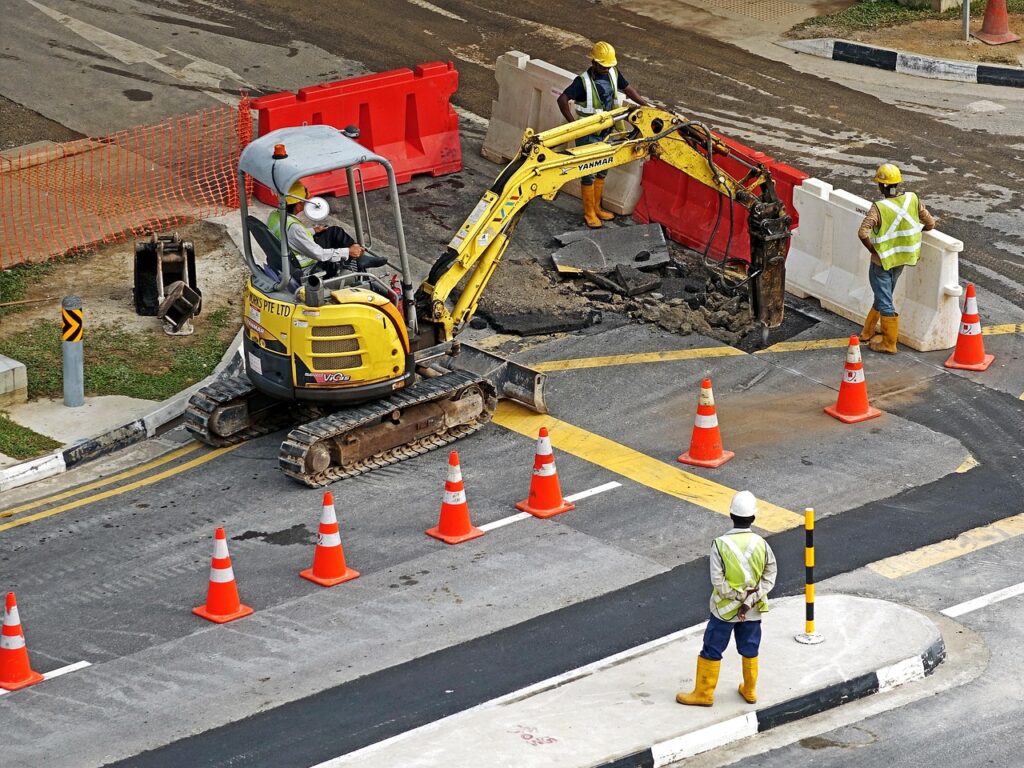
Motorists constitute more than eighty percent (80%) of the fatalities in work zones. Road Authorities are responsible for the safety of these motorists and they must establish and enforce the criteria that contractors must follow to design a safe work zone.
The Qatar Work Zone Traffic Management Guide is the applicable standard which will be covered in this course. Attendees will learn how to design a safe work zone and they will learn about the newest technologies for work zone safety. The use of positive protection from crash worthy barriers, truck mounted attenuators, dynamic, variable message signs, average speed camera enforcement and flagger training will be among the topics discussed.
Another important part of the Work Zones is the use of vertical signs and road markings, which will also be covered in depth on this course.
This training is applicable for Road Agency Executives, Highway and Street Engineers, Traffic Safety Professionals, Planners, Design Consultants, Law Enforcement, Research & Academia, Contractors, and Road Product Suppliers & Distributors.
2. Course Results / Objectives
- Understand that the road authority is responsible for the safety of its motorists in a work zone.
- Comprehend how to design a safe work zone for both motorists and workers.
- Understand the current status of work zone safety.
- Learn how to use the Work Zone Traffic Management Guide locally as well as the process to submit a traffic control plan for approval by the authorities.
- Learn about global best practices and state of the art technologies and concepts for work zone safety.
- How to check and approve Work Zones.
- Discussion over different relevant examples of Work Zones.
- Design and characteristics of the vertical signs.
- Properties and location of the road markings.